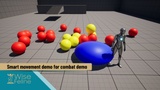
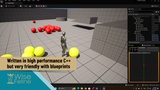
Açıklama
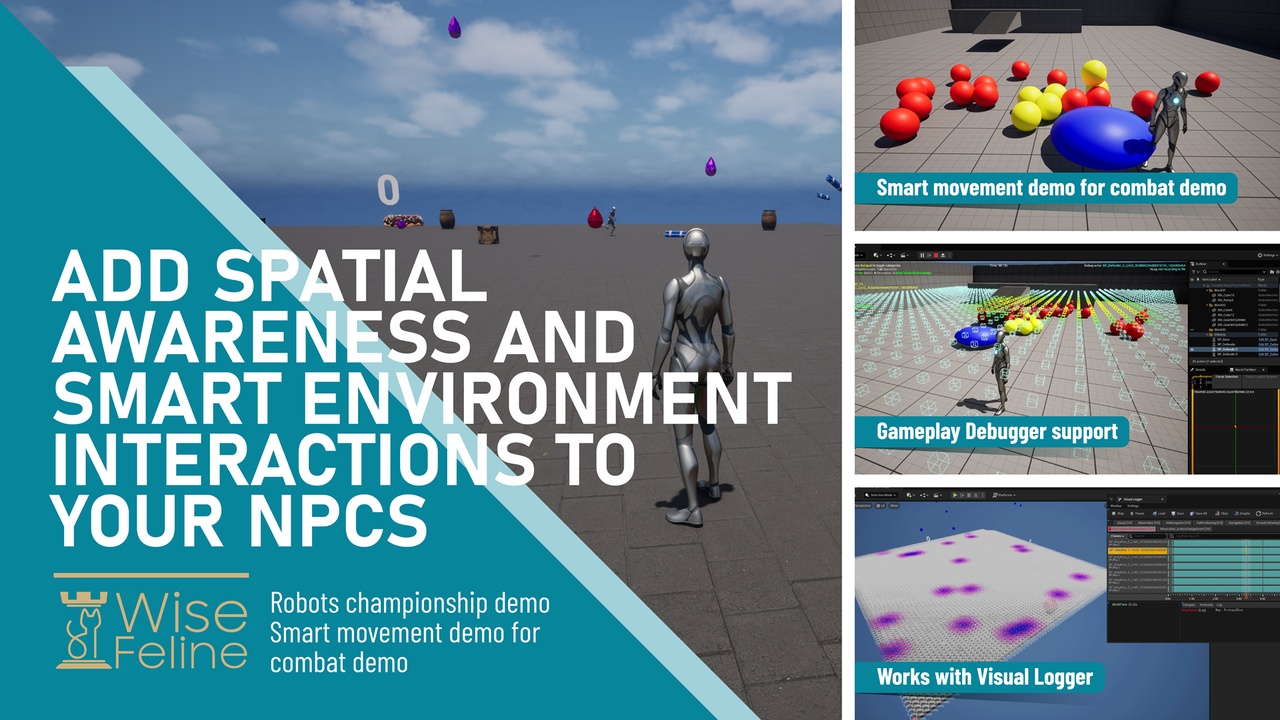
An influence map is how your AI understands space. Stamp what matters - enemies, allies, cover, noise, fire, scent, population density - onto a grid, combine the grids, then ask questions of the whole environment instead of testing one point at a time.
New in 3.1: author templates with an AI agent. On UE 5.8, an optional editor module connects to the engine's MCP server, so an agent working in your editor can create influence map templates, shape their falloff curves and read them back. The 5.7 and 5.6 versions ship without it.
Faster searches, and a cheaper idle map. The highest and lowest value searches now run as two SIMD passes, and a map no longer loops over its cells every tick unless the Visual Logger is recording. They join the SIMD map operations from 3.0: adds, strength-weighted adds, normalization and template stamping all process 4 cells per instruction. Larger maps, higher resolutions, more maps per frame. Release notes
Introduction video | Demo video | Quick start guide | Documentation
Questions an influence map answers in one query:
Where do I stand so I'm not too close to my friends and not too far from the enemy?
Where do I throw the grenade to hit the most enemies?
Which routes do the cargo convoys actually use, so I can send the raiders there?
Where is the safest path home when half the map is on fire?
Where does the next house go, given current population and building density in my procedurally generated town?
It also drives simulation directly: fire, ice, heat, scent trails and any other cellular automata you want to run over a grid.
How it works
You store an agent's, object's or event's effect on a map as a stamp, then search for high values, low values, averages and more. Maps combine with each other - add, multiply, normalize one map against another - at any resolution you choose, with decay over time, and the raw arrays are there when you need them. Everything is available in both Blueprints and C++.
Unlike EQS, an influence map tells you about the whole environment rather than the current position of a handful of actors - and because values persist and decay, it remembers what happened where, not just what is there now. A comparison of EQS, influence maps and graphs for spatial decision making
Why this one
CPU and deterministic - runs on dedicated servers and in networked and replay-safe code, on every platform, with no GPU readback latency and no render-thread dependency.
Debuggable - gameplay debugger and visual logger integration, plus map-to-texture output for radars, minimaps, Niagara VFX and heatmap overlays.
Reusable templates and decay built in, so a stamp is authored once and fades correctly on its own.
Plugged straight into decision making - a query result becomes a score for our Wise Feline Utility AI considerations, and it works just as well behind Behavior Trees or State Trees.
See both plugins working together
Robots Championship demo: video | playable exe | influence maps breakdown | Tutorial combining Utility AI and influence maps
Discord server | X/Twitter | Newsletter - news and sale announcements