설명
A data-driven arcade car with client-predicted netcode, drift boosts, and race AI that calibrates itself to whatever car you build.
Build a car once. Everything else adapts.
This system is a complete arcade driving foundation: a fixed-step, fully deterministic vehicle simulation, multiplayer netcode built with real AAA structure, and race AI that learns how your car corners instead of asking you to tune it.
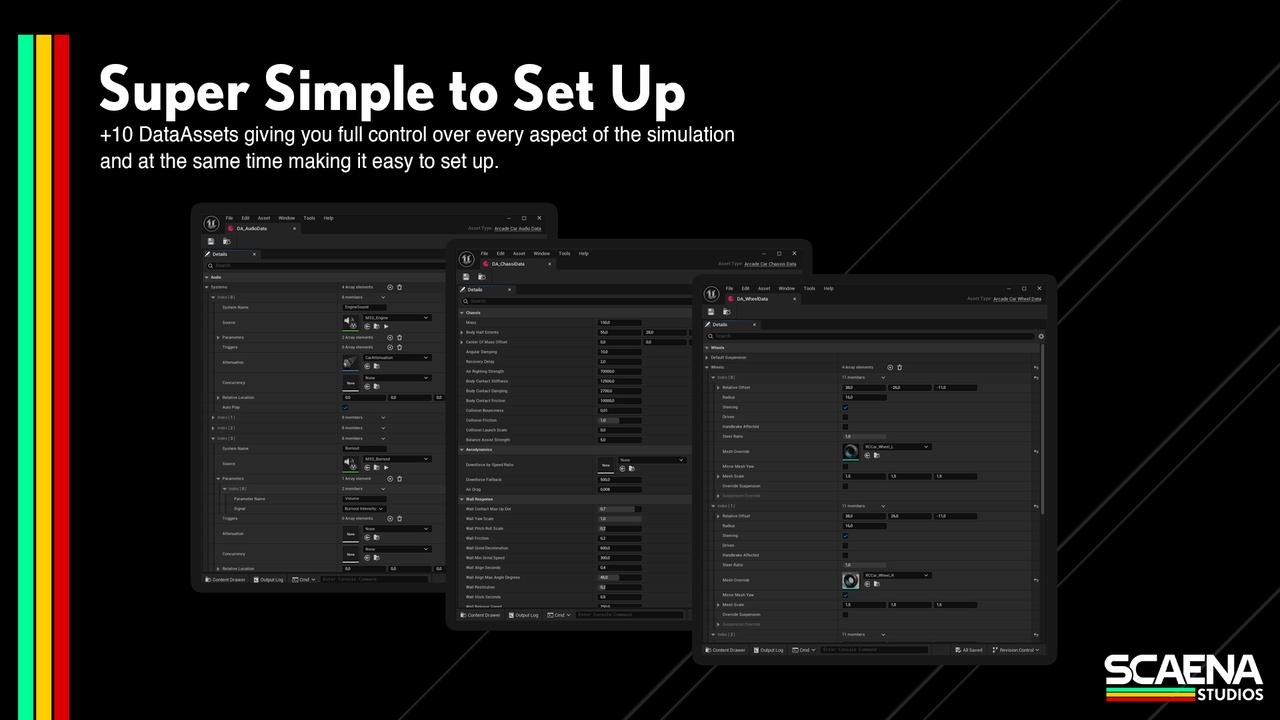
Every number lives in data assets. Mass, torque curve, wheel layout, grip by slip angle, drift entry and exit angles, boost strength, camera, feedback, audio: tweak them in the editor and the car, the network prediction, and the AI opponents all follow. No hidden constants, no code changes.
Driving that feels like an arcade racer
Handbrake-initiated drifts with separate entry and exit slip angles, so a slide is easy to start and easy to hold
Drift boost: hold a slide inside the angle band to charge, release to fire
Rocket start on the grid and burnouts on the line, with body tremble and wheel spin
Per-surface grip, rolling resistance, contact VFX and skidmark materials keyed by physical material
Speed-scaled steering with counter-steer assist, tuned by curve
Suspension traces per wheel, air control, upright recovery and stuck detection
AAA Netcode
120 Hz fixed simulation tick with server-side input buffering
Clients predict their own car and every remote car, so contact between players resolves smoothly instead of snapping
Tolerance-based correction on position, rotation and velocity, with redundant input packets to ride out loss
Measured, documented cost: eight cars is comfortable, and the docs tell you exactly what each setting buys
Race AI that calibrates itself to your car
This is the part you won't find elsewhere. When an AI car spawns, it runs your car's simulation offline against a flat track and measures how much lateral grip it has at every speed, how fast it can hold a technique drift, how fast it can hold a boost-charging drift, how much throttle keeps that slide alive, and how far a handbrake slide scrubs speed. From that profile it solves corner speeds for the real track geometry ahead of it.
The result: change the grip curve, the torque, the drift angles, even gravity, and the AI re-learns the car and races it at its limit. No per-car tuning, no behaviour trees to rebuild.
Drifts corners instead of braking, and charges boosts on long corners the way a skilled player would
Senses guardrails and walls with sweeps, so it uses the width of the road without leaving it
Corridor path component with per-sample curvature, run sweeps and lateral room for line choice
Rival awareness: attack and defend ranges, launch timing error on the start
Difficulty is a data asset: grip usage, reaction time, lookahead, and a mistake chance with its own braking and lookahead multipliers. Leave mistakes at zero and it is very hard to beat
Respawn, stuck recovery and reverse-out handling built in
Feedback and audio
Spring-arm camera with lag, speed-driven field of view and impact camera shake
Niagara drift and dust effects and projected skidmarks with lifetime and fade, all thresholded by slip
Audio driven by named parameters (engine RPM ratio, speed, slip, boost) with impact and landing triggers: plug in your own MetaSounds or cues
Built for engineers
The simulation step is a pure function: same inputs, same outputs, on every machine, every time
Enhanced Input out of the box: throttle, brake, steer, handbrake, reset
Capture console commands write a per-car, per-frame CSV (inputs, speed, drift angle, boost, AI decisions, network error) for real analysis of a real session
Live network overlay and an AI profile dump for debugging
Automated test suite covering simulation, netcode, path queries and AI racecraft
Full C++ source, Blueprint-exposed pawn and components, and a documentation PDF that explains every setting and what it was measured to cost
Arcade Car System is the driving, networking and opponent layer of an arcade racer, ready for your cars, your tracks and your game rules on top
Technical details
Features:
Deterministic fixed-step arcade vehicle simulation (pure-function step)
Client-predicted networked movement for local and remote cars (Rocket League model)
Handbrake drifts with entry/exit slip angles, drift boost, rocket start, burnout
Self-calibrating race AI with drift and boost racecraft, wall sensing and data-driven difficulty
Corridor path component with curvature analysis for AI lines
Per-surface grip and effects by physical material
Niagara drift/dust effects, projected skidmarks, camera lag/FOV/shake
Parameter-driven audio with impact and landing events
Enhanced Input integration
Capture-to-CSV, network overlay and AI profile debug commands
Automation test suite
Code modules:
ArcadeCarSystem (Runtime)
ArcadeCarSystemEditor (Editor)
Number of Blueprints: 0 (Blueprint-subclassable pawn and components)
Number of C++ classes: 25 (pawn, movement, input, audio and feedback components; 13 data asset types; AI driver, calibration subsystem, corridor path; collision, capture and overlay subsystems)
Network replicated: Yes
Supported development platforms: Win64
Supported target build platforms: Win64
Dependencies: Enhanced Input, Niagara (enabled automatically)
Documentation: Setup guide, settings reference and a full documentation PDF included with the plugin
Example project: Included
Important: C++ project required. Built and tested on Unreal Engine 5.8.1.