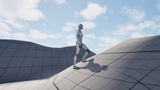
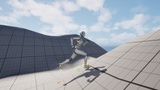
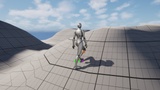
Descrizione
Lean In Motion
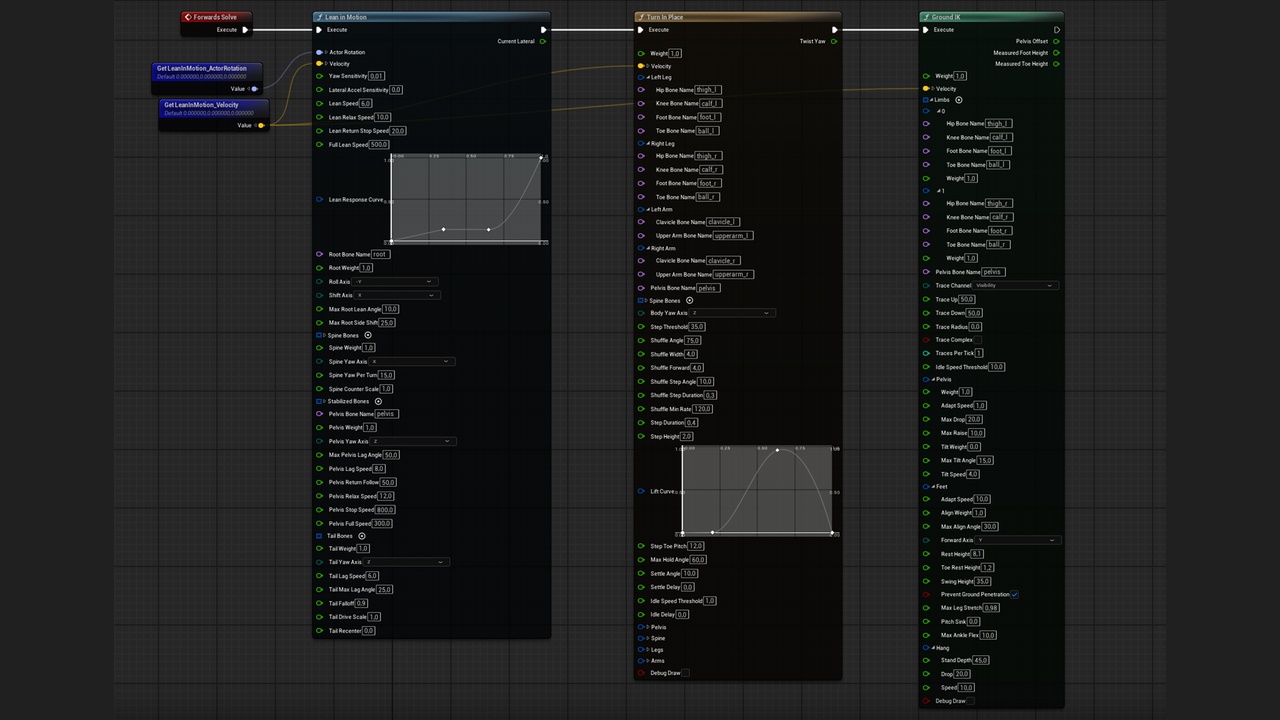
Three C++ Control Rig nodes that add procedural motion to any character — no extra
animations, no anim graph rework. Wire in two values (actor rotation and velocity), pick
your bones, and the nodes do the rest. Use any one on its own, or chain all three:
Lean in Motion → Turn In Place → Ground IK.
LEAN IN MOTION — the body answers the turn
• Root banking and weight shift — the body leans and shifts into the turn
• Spine twist with chest anchoring — hips swing, chest keeps leading the way
• Pelvis lag — the hips trail the feet instead of sliding them
• Travelling-wave lag for tails, capes, antennae — any chain
• Gaze stabilization — the head holds its aim through the lean
• Reads how the movement curves, so a quick reversal produces no false lean while real
cornering leans fully
• Strafe-aware, fades out while airborne
GROUND IK — the feet find the ground
• Traces the ground under every foot itself; two-bone IK keeps the animated knee bend,
no pole vector setup
• Contact is latched in world space and held for the whole stance, so stair pops and
capsule jitter never reach the foot
• Swing feet aim at a predicted landing spot — the correction settles before touchdown
instead of snapping at it
• Foot pitch from two ground samples, ankle and toe: stays correct standing sideways
across a slope
• Ledges — a foot over a drop hangs into it and the pelvis sinks with it as one unit
• Ankle flex limit stops the shin folding through a planted foot
• Bipeds, quadrupeds, anything with legs — any number of legs
• Traces are spread across frames and suspend entirely while standing still
TURN IN PLACE — the feet hold their ground, then step around
• The feet stay planted while the body turns, and step once the twist builds up
• Error-driven, not timed: interrupted, reversed and partial turns just work
• Spiral wind-up — the hips follow partway and the spine unwinds that lag, so the chest
keeps facing where the player is aiming
• Knee budgeting stops the hips following further than the legs can afford
• Weight transfer onto the stance foot, with pelvis tilt and spine levelling
• Long, fast turns switch to a shuffle: the feet pull in under the hips and take small
quick steps until the turn is over
• Arms and clavicles answer the wind-up on a spring, so they dangle rather than track
stiffly
WHAT YOU NEED
Any skeleton. No root motion, no distance curves, no state machine, no extra animations —
two input values and your bone names.