

説明
Demo Level Available – Download HERE !
Experience the functionality first-hand with our demo level. Simply click the link above to download and explore the plugin in action!
Overview
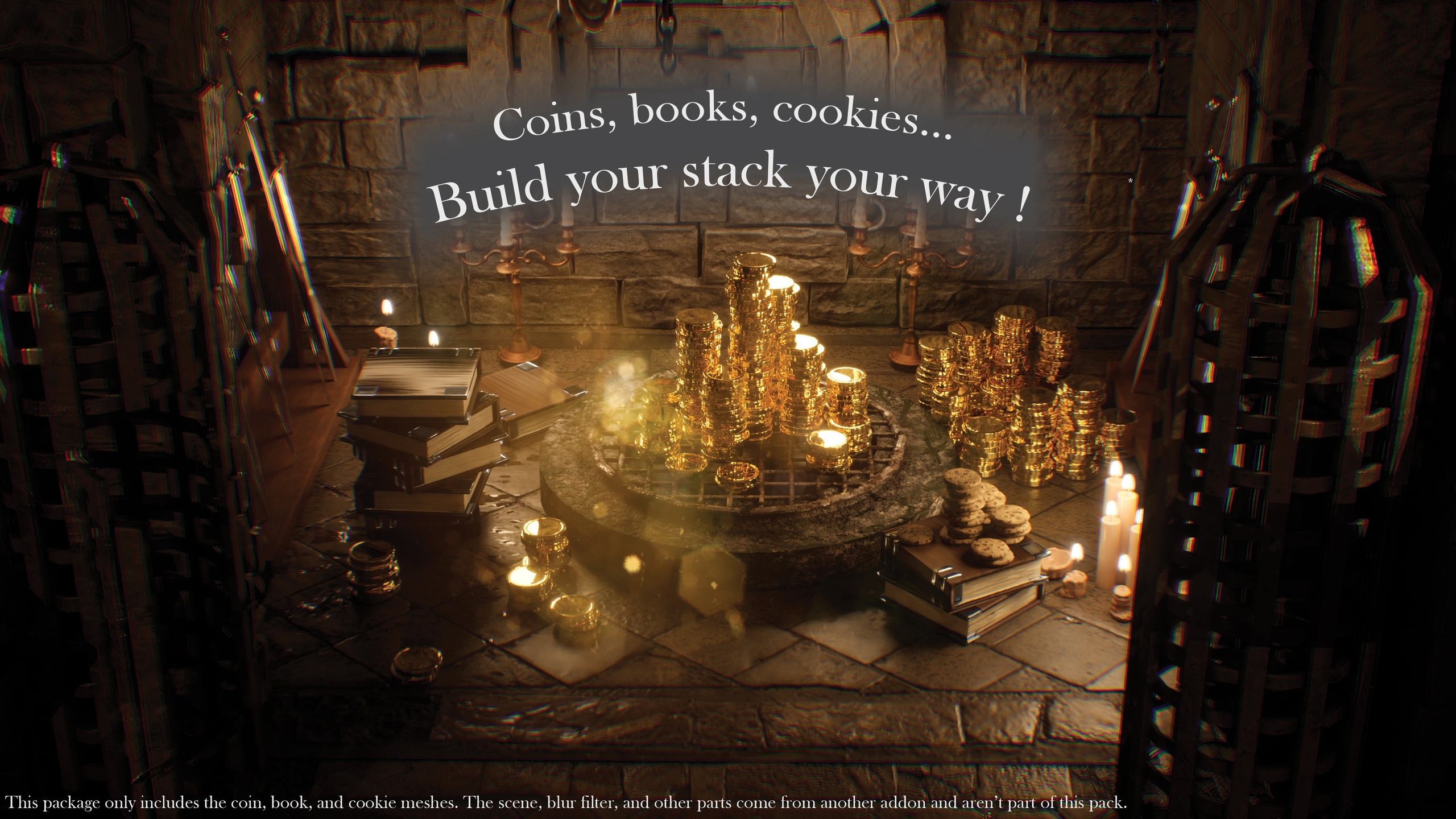
HoardCS is a powerful plugin that enables you to procedurally generate stacks of objects—referred to as “hoards”—directly within Unreal’s level editor. The system is engineered to be user-friendly, yet highly customizable, making it an ideal solution for both rapid prototyping and refined design.
Quick & Easy Setup
Creating a hoard is as simple as 1-2-3-4:
New Coin
Edit Coin Stacks
Regenerate Coin Stacks
Apply to Current
In just four clicks, a new hoard is generated, providing an instant visual representation of your setup.
Advanced Customization
For users who desire a more tailored approach, HoardCS offers a total of 24 parameters accessible via the hoard editing panel. These options let you fine-tune the procedural generation settings to match your exact vision. Moreover, each individual stack within a hoard can be manually adjusted, ensuring that the final arrangement meets your precise expectations.
Demo Meshes & Custom Assets
To help you get started quickly, the plugin includes three demo meshes:
A coin
A book
A cookie (for those with a sweet tooth!)
If you already have a clear idea of the objects you want to stack—be they fish, boards, plates, or anything else—HoardCS allows you to import and stack your own static meshes, so your creativity can truly run wild.
Static vs. Dynamic Hoards
HoardCS provides two types of hoards:
Static Hoards: Optimized for performance, these are perfect for scenarios where the arrangement remains fixed.
Dynamic Hoards: With the ability to adjust the number of visible instances at runtime, dynamic hoards offer stunning visual effects. This is ideal for in-game collection systems where items add up in real time as the player collects them, replacing static, unresponsive piles with an engaging, evolving display.
Efficient Collision System
The plugin features an advanced collision system with multiple options:
Disable Collisions: Reduce overhead when collisions aren’t needed.
Capsule Collisions: Generate collisions via capsule shapes either for the entire hoard or for individual stacks, significantly reducing performance impact compared to traditional per-object collision handling.
Data-Oriented Design for Future-Proofing
At the core of the Coin Hoard system is a data-oriented architecture:
An ACoinHoardStacked actor is essentially a representation of a UCoinHoardStackedDataAsset that holds all the necessary data.
This design allows for:
Data Sharing: Retrieve and share data between different Coin Hoards.
Unified Modifications: Update shared parameters across multiple hoards simultaneously.
Custom Data Assets: Create unique Data Assets for specialized hoard configurations.
This approach not only simplifies data management but also ensures excellent update compatibility. New versions of the Data Asset can be introduced without breaking older ones, allowing you to take advantage of enhancements while maintaining backward compatibility. For shipping builds, you can remove the Data Asset from static hoards to save memory—only dynamic hoards need to retain their Data Asset at runtime.
Get Involved!
HoardCS is in constant evolution. If you have any ideas, suggestions, or feedback, please share them! Your input is invaluable in helping us shape future improvements.