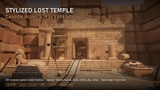

Açıklama
Build lost temples, desert ruins, canyon passes, excavation sites and expedition camps for adventure and action games, puzzle levels, RPG dungeons with an entrance from the surface and cutscenes, from one consistent stylized kit. Temple floors, walls, ceilings, cornices and parapets are 2 m modules on a 2 m grid with 4 m and 6 m doorways; the canyon is built from 4 m and 8 m cliff walls with inner and outer corners, ends, an overhang, rock caps over the halls and a natural arch. Architecture and walkable ground have collision, every mesh has lightmap UVs, and the materials are tiling PBR sets with tweakable wear, grime, dust, a close-up detail normal and a glow control for every lamp and flame.
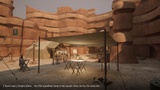
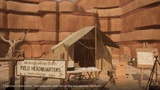
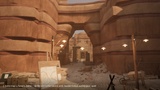
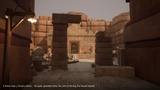
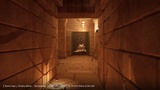
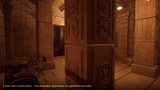
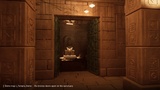
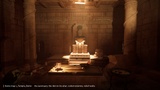
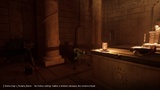
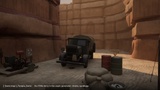
A box canyon, late afternoon, 1934. The Halden Exploration Society has camped under the overhang: tents, a field headquarters with its desk, typewriter and map easel, the cookfire and a line of festoon lamps that leads up the slot under the natural arch. Past the gate with its guardian lions the courtyard opens before the half-excavated temple facade: scaffold and a hoist on the carved wall, rails running out of the shored portal to the spoil heaps, finds trays and sieves. Inside, the passage leads by lamplight to the antechamber with its glyph pillars and through the open bronze doors to the sanctuary, where the seated idol waits on its altar under a fallen ceiling. The culture is invented; the mood is adventure and mystery, not horror.
What's inside: 250 static meshes in 10 categories
Canyon cliffs (15): 4 m and 8 m cliff walls in several cuts, a low and an upper wall, inner and outer corners, a cliff end, the overhang, two rock caps and a cap with a light shaft, and the natural arch; layered sandstone strata.
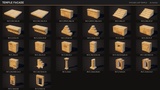
Temple facade (26): floor slabs, platform edges and steps, plain, accent, corner, relief, damaged and ruined walls in 1 and 2 m, cornices and parapets, a stepped portal, tunnel modules and a tunnel end, columns whole and broken.
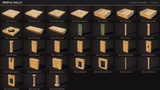
Temple halls (31): plain, inlaid and broken floors, plain, cracked and holed ceilings, wall modules with reliefs, a niche, damage and upper courses, corners and pilasters for 4 m and 6 m halls, 4 m and 6 m doorways, the bronze doorway with its two leaves, square pillars and coiled hall columns whole and broken.
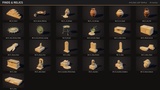
Finds & relics (25): the seated idol, the altar and a dais, a guardian lion on its plinth (whole, headless, the plinth empty), a colossal head, a statue hand and foot, stelae whole and fallen, a carved block, a stone coffer, braziers, bronze discs, urns, storage jars, offering bowls and a crown.
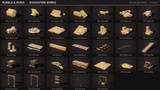
Rubble & ruins (15): fallen column drums, a capital, a cornice and a lintel, fallen blocks, a masonry fall, rubble piles, ceiling debris, broken paving and steps, ruin walls, a ruin corner and a ruined gate.
Excavation works (18): narrow-gauge rails straight, curved and on a ramp, two skip carts (loaded and empty), a boardwalk, beams and plank stacks, sandbag walls and piles, spoil heaps and ridges, a windlass, tunnel shoring and the shored portal, a scaffold bay, shear legs and a hoist gantry.
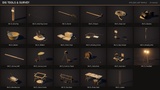
Dig tools & survey (23): grid pegs and string lines, shovels, a pickaxe, rope, buckets, baskets, riddles, finds trays and a finds table, a drawing frame, a danger sign, ranging poles, a survey staff and level, a camera on its tripod, a cable reel, a generator, a floodlight, a wheelbarrow, a sieve trestle, a tool rack and a ladder.
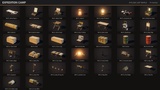
Expedition camp (37): ridge, fly and large wall tents, a 1930s lorry, the field desk with papers, typewriter and field radio, a map easel, a camp table, cot, bedrolls, stools, folding chairs and a washstand, lanterns and a pressure lamp, crates, chuck box, trunk, drums, water bags and sacks, the campfire with a kettle tripod and firewood, the HQ sign, a signpost, lamp posts, a 4 m festoon lamp string, a laundry line and a flag pole.
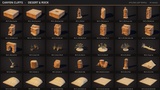
Desert & rock (20): grass tufts, dry bushes, a snag log and a dead tree, boulders and a boulder cluster, a rock pillar, a scree fan, sand drifts and a slope, and 8 m ground tiles of sand and gravel.
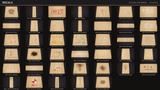
Mesh decals (40): sand drifts, edges, ripples and spills, boot prints, drag marks, barrow and tyre tracks, chalk grids and marks, survey datums, block numbers, cracks, salt bloom, water seeps, varnish streaks, lichen, soot from ancient fires and from the expedition lamps, painted mural bands, discs and figures, plaster patches, hand prints, a stencil of the society, sherds, ash, grit, dry leaves, camp litter and an oil stain.
All glyphs, murals, emblems and lettering are invented and drawn by our own procedural tools: no real culture's sacred symbols, no real brands, flags or organisations.
Two maps
L_Temple_Demo: one connected walk through a box canyon on a late afternoon. From the expedition lorry in the wash through the camp under the overhang, up the slot under the natural arch, through the gate into the courtyard before the temple facade and the dig, then the lamp-lit passage, the antechamber and the sanctuary under the fallen ceiling. About 1,100 m² to walk, real-time Lumen, volumetric fog, a low sun and 31 movable lights in festoon strings, floodlights, lanterns, lamp posts and the campfire, plus the shaft of light through the sanctuary ceiling. Press Play to walk through.
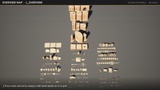
L_Overview: every mesh laid out by category with name labels on a 1 m grid.
Materials you can tweak
6 master materials and 55 material instances. The surface instances expose tint, tiling, edge wear, height-based grime, dust, macro variation, a detail normal for close-ups and a roughness override; lamps and flames have a glow strength. The canyon strata, the sandstone and the sand take world-space tiling, so neighbouring modules continue each other.
Game-ready
Collision: per-poly (complex as simple) on 102 architecture and ground pieces (floors, walls, ceilings, doorways, steps, the portal and tunnel, cliffs, the arch, rock caps, ground tiles, sand and spoil, ruins, rails, boardwalks, scaffold, shoring, the hoist, tents, the ladder and lamp posts), so doorways, the portal and the tunnel stay open; simple collision on 79 props (59 single hulls and 20 convex decompositions for tables, cots, carts, the wheelbarrow, the guardians, the colossal head, the lorry and other concave pieces); none on 69 (40 decals, lamp strings and the laundry line, grass and bushes, hand-sized dressing).
LODs on 80 props (LOD0–3; fewer where thin legs or the map sheet would break); architecture, decals and small pieces have a single LOD.
Lightmap UVs on every mesh, in UV channel 1.
Clean topology: no hidden buried faces and no overlapping coplanar faces (checked by our own gates before export).
No Nanite needed. All lights are movable, so there is no light baking.
One download for Unreal Engine 5.1 to 5.8. It is content only: no code, no plugins.