
Description
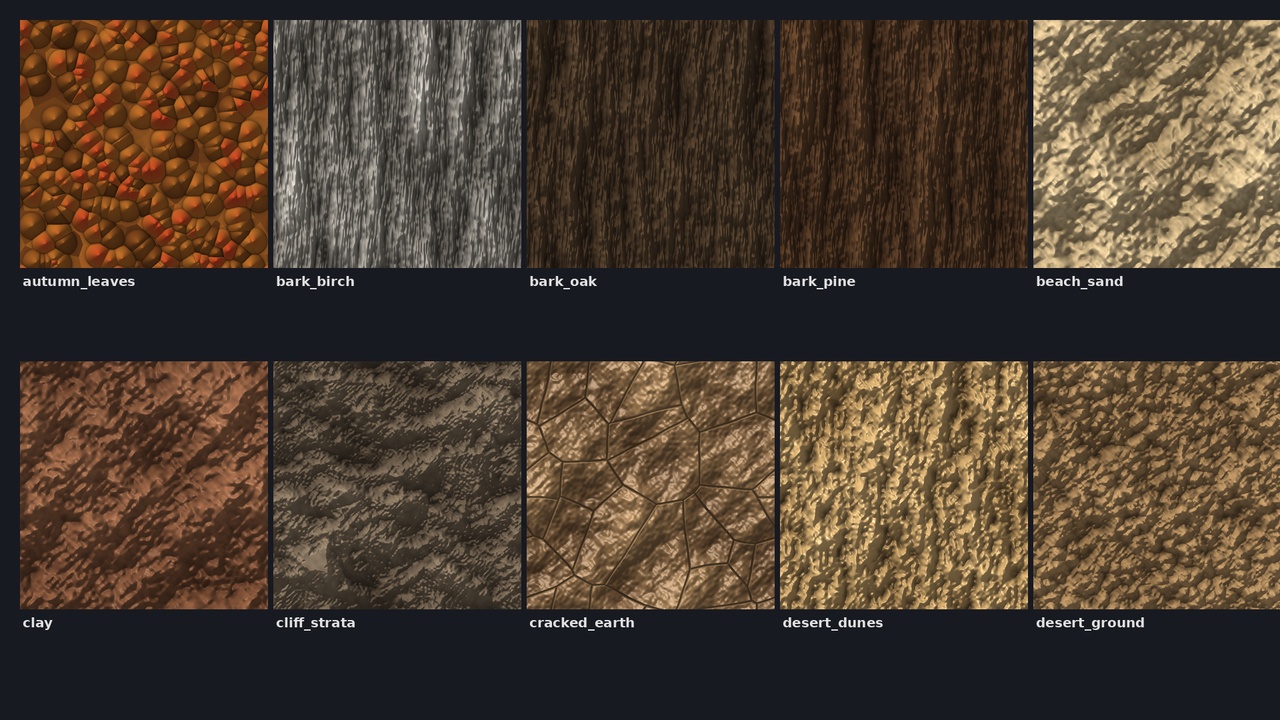
Thirty-two tileable PBR materials: the ground, growth and water of an outdoor scene. They arrive as real materials in both engines - Unity materials for whichever render pipeline you use, and Unreal material instances off one master - so a surface is assigned, not assembled.
WHAT YOU GET
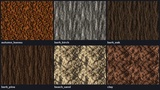
Grass: grass, lush, dry, meadow, moss, tall grass. Earth: dirt, dirt path, mud, clay, cracked earth, forest floor, swamp ground. Sand: beach, dunes, desert ground. Rock: rock face, cliff strata, granite, volcanic, pebbles, river pebbles, lichen stone. Trees: oak bark, birch bark, pine bark, autumn leaves. Cold and wet: snow, fresh snow, ice, calm water, rough water.
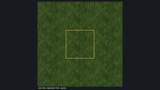
The grass is drawn as warped blade strands, not green noise; the ice cracks between pressure plates; the water is glassy with its shape in the normals and the gloss, with whitecaps on the rough variant.
UNITY
Unity 2021.3 or newer, and all three render pipelines are covered. A Unity material names exactly one shader, and Built-In, URP and HDRP use three different ones, so the pack keeps them apart rather than shipping ninety materials that bind to shaders your project has not installed: the Built-In materials sit ready to use, and URP and HDRP each ship as a nested .unitypackage you double-click if that is your pipeline. Nothing in the pack imports magenta whichever one you are on.
Textures come in with their import settings already right - normals flagged as normal maps, roughness, height and occlusion linear rather than sRGB - and the packed metallic-smoothness map is written at build time, so there is no smoothness-versus-roughness inversion to do by hand. A demo scene lays all thirty-two out on lit slabs.
UNREAL
Unreal Engine 5.8. One master material, M_NatureTerrainMaterialsVol1Master, with thirty-two material instances hanging off it - so you change the master once and every surface follows, and switching a material at runtime costs nothing. The master samples a packed ORM map, which is the layout Unreal's own content uses, so metallic, occlusion and roughness unpack from one texture read instead of three. Tiling is exposed on every instance, so ground that runs to the horizon and a patch under a prop can share a material and still read at the right scale. A demo level lays the set out the same way the Unity scene does.
ANY OTHER ENGINE
The raw maps ship alongside both formats: 1024x1024 PNG, albedo, normal, roughness, height and ambient occlusion per material. Godot, or anything else that reads standard PBR maps, takes them directly.
SEAMLESS BY CONSTRUCTION
Every map tiles in both directions, and that is verified numerically at build time - the tile edge is checked against the interior before anything is written - not eyeballed. The five maps of a set agree with each other because all five are derived from one authored surface: the normals are the height's slope, the occlusion is its self-shadowing, the roughness is authored against the same masks.
METALNESS
Set per material rather than guessed from the albedo. This is an outdoor set, so every material in it is a dielectric: ground, rock, bark, snow and water are all non-metal, and the packed maps say so rather than leaving it to chance.
STYLE
Stylized-painterly rather than photo-scanned: clean shapes, readable at a distance, consistent across the whole set - built to sit together in one scene without one material looking like it came from a different pack.
Features:
Number of Unique Materials: 32
Number of Textures: 256
Texture Resolutions: 1024x1024
Number of Meshes: 0
Number of Unique Meshes: 0
LODs: No
Number of LODs: 0
Supported Development Platforms: Windows, macOS, Linux
Supported Unity Pipelines: Built-In Renderer, Universal Render Pipeline, High Definition Render Pipeline
Documentation Link: https://taproot-ue-packs.web.app/docs/nature-terrain-materials-vol1.html
Dependencies and prerequisites: None. Unity 2021.3 or newer; the materials are stock Unity shaders and the textures are plain PNGs, with no third-party packages. The Unreal Engine format requires Unreal Engine 5.8 and uses only stock material nodes.