Opis
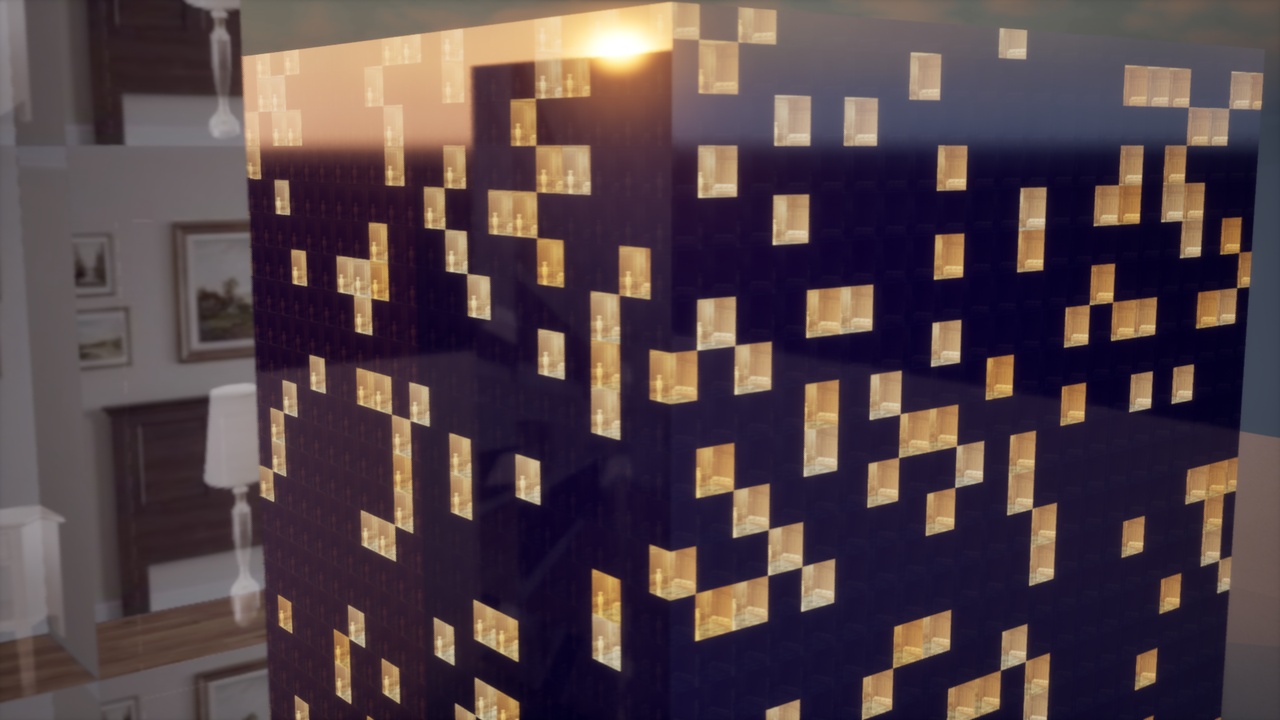
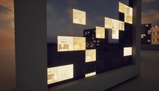
Volumetric rooms behind every window, drawn by one opaque material. No interior geometry, no translucency, no extra draw calls.
A thousand windows with real rooms behind them, and not one triangle spent on any of them.
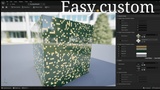
Fake Interior Pro is an interior mapping material for Unreal Engine 5. Put it on a box and
every window cell gets its own room, its own furniture, its own lit-or-dark state and its own
blinds — all from where that cell sits in object space. The whole effect is one Custom HLSL
node on an opaque, default-lit surface: no translucency sorting, no overdraw, no second pass.
Fourteen building presets ship with it, and they are buildings rather than tints: a night
office reads differently from a panel block, a hotel from a derelict, a car park from a
shopping centre. Drop the preset on a shell and the facade is done.
WHAT MAKES IT DIFFERENT
Analytic intersection, not ray marching. Cost per pixel is constant and does not grow with
room depth. 666 pixel shader instructions with everything turned on.
One sampler, one texture array. Back wall, side walls, ceiling, floor and four furniture
sprites live in a 3x3 cross per slice. Furniture is composited from its own depth plane, so
it parallaxes against the back wall instead of being painted onto it.
Every room is different, and so is every building. Randomisation comes from a hash of the
room cell folded with a per-actor seed, so two identical meshes side by side do not produce
the same pattern of lit windows — the one thing that gives a tiled facade away.
Facades that are alive. Windows switch on and off over time on their own schedule, some rooms
are lit by a flickering screen rather than a lamp, blinds and curtains hang at different
heights, and grime runs down the glass. One slider controls how much of that happens.
One collection moves the whole city. Time of day, sun position and window occupancy live in a
Material Parameter Collection: one Blueprint call or one Sequencer track takes a skyline from
noon to midnight without a dynamic instance per building.
WHAT YOU GET
A start level that explains the shader in ten seconds without opening a document, a night city
and a daylight scene, fourteen building presets with twenty-eight glazing variants, and camera
bookmarks and Sequencer flythroughs used to shoot every image on this page.