











Description
Editor Execution Layer gives external tools, AI agents, scripts, QA systems, and production pipelines reliable hands and eyes inside Unreal Editor.
It exposes real editor operations through a controlled local execution layer: inspect project state, run editor actions, reread the result, and verify what actually changed — without UI scripting, screenshots, simulated clicks, or guesswork.
Unreal Editor is powerful, but large projects quickly become difficult to audit, migrate, validate, and maintain by hand. Editor Execution Layer turns the editor from a workstation-only tool into an operable production surface for automation, asset ingress, project intelligence, graph authoring, large-world workflows, and verified editor operations.
Not another prompt toy.
Not hidden automation.
Real editor actions. Checked results.
What you get
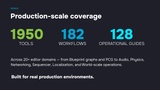
Editor Execution Layer exposes 1,950 real editor operations, 182 workflow routes, and 128 operational guide resources across 20+ Unreal Editor domains.
The platform combines low-level atomic editor operations with higher-level workflow routes, query layers, guide resources, and operator controls so external systems can work with Unreal deliberately instead of guessing.
Public User Guide:
setup, authorization, MCP client examples, CLI arguments, endpoints, Operator Console usage, and workflow examples:
Editor Execution Layer User Guide.
The public guide also includes setup, authorization, troubleshooting, and support-diagnostics instructions for reproducible issue reports.
Core capability pillars include:
• Project intelligence through Audit Query Layer and Competence Query Layer for structured project inspection, capability routing, and guided operation
• Asset Ingress Channel for controlled external asset import through MCP and HTTP
• Blueprint, Material, Niagara, Widget, PCG, Sequencer, and Texture Graph operations
• Level Design, World Partition, Landscape, Foliage, Lighting, and large-world tooling
• Static Mesh, Skeletal Mesh, Animation, IK Rig, Retargeting, and Control Rig workflows
• AI Decision Systems, GAS, Networking / Replication, Physics / Chaos, Audio, and Localization
• Packaging, plugin, project settings, viewport, session, and editor-system inspection
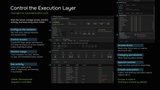
• Operator Console access control, activity visibility, response modes, and execution telemetry
Built for production pipelines
Editor Execution Layer is useful with AI agents, QA automation, CI/CD pipelines, asset generation services, browser tools, external orchestration systems, custom production scripts, technical artists, and tools programmers.
AI is only one possible operator. Any system that can call the execution layer can inspect, operate, and verify Unreal Editor state through the same controlled surface.
Verification-first operation
The platform is built around a simple discipline:
Inspect → Mutate → Reread → Verify
A successful operation should match real editor state. Unsupported operations fail explicitly. Partial failures are reported. No workflow relies on screen scraping, fake editor state, or hidden UI interaction.
This matters because production automation is only useful when the result can be trusted.
Secure by explicit authorization
Editor Execution Layer does not grant editor access by default.
Anonymous access must be explicitly enabled by the operator. API keys must be explicitly created and used. Permissions are controlled through the Operator Console, including special controls for sensitive operations.
There is no hidden editor exposure by default.
Editor-only architecture
Editor Execution Layer runs inside Unreal Editor and has no runtime dependency in packaged builds.
It is an editor-side execution and verification layer built on native Unreal Editor systems. It does not replace Unreal Editor, does not add gameplay runtime requirements, and does not modify packaged games.
What it is not
Editor Execution Layer is not a “make a game” button.
It is not a visual scripting replacement, not an AI content generator, not a UI automation macro recorder, and not a hidden black-box agent.
It is a production execution layer for Unreal Editor — built to make real editor work inspectable, callable, repeatable, and verifiable.
Operate Unreal Editor with confidence.