描述
Author a PCG node's settings right where you use them.
No settings asset, no content-browser round-trip.
→ Documentation
→ Source
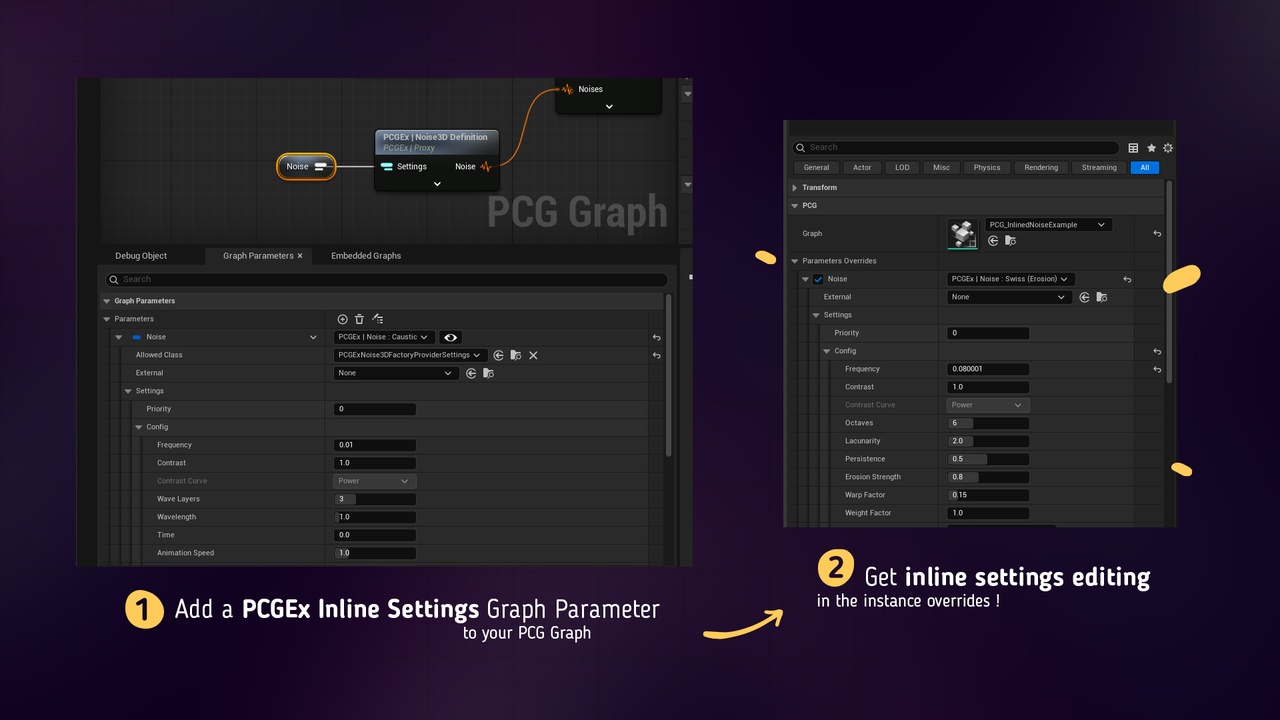
A PCG graph can only run settings that live somewhere: on a node, or in a saved settings asset. Inline Settings gives them a third home: a graph parameter.
Add a PCGEx Inline Settings graph parameter, pick any settings class the palette offers (preconfigured variants and Blueprint elements included), and edit its properties inline in the details panel; and in graph instance and component overrides, where each instance can take its own local copy. Point the parameter at a settings asset instead when the settings should be shared.
Everywhere PCG reads the parameter (override pins, Get Graph Parameter, subgraph pins) it sees one soft object path to the effective settings. Feed that path to the PCGEx | Proxy node and it runs them. The proxy's interface can be an abstract class, so a single node stands in for a whole family of PCGEx sub-nodes (filters, noises, tensors, probes, heuristics, selectors...), and extra input pins you declare on it are forwarded to the inner settings by label.
Highlights
🧩 Inline settings parameter ➝ any PCG settings class, authored in the details panel and per-instance in override panels. Restrict the picker with an Allowed Class.
📦 Asset or inline ➝ an External settings asset takes over from the inline instance when set; clear it and the inline values are back untouched.
🎛️ Only the rows you need ➝ node plumbing (debug, asset info, GPU, determinism) hidden by default, project-wide hide rules, and a per-parameter eye popover to force properties or whole categories shown or hidden.
🔌 PCGEx | Proxy node ➝ runs the settings behind the path. Concrete or abstract interface classes (PCGEx tags all its sub-node bases), overridable Settings, extra input pins forwarded to matching inner pins, outputs tagged by inner pin.
⏸️ Async-aware hosting ➝ inner pausing, dynamic dependencies, abort, main-thread needs and GC references are bridged; choose next-tick polling or re-dispatch while the inner waits.
🧑💻 C++-ready ➝ FPCGExInlineSettings works as a property on your own nodes and objects: allowed class in the constructor, Resolve() at execution.
Free and open source. The full source is MIT-licensed on GitHub.
The paid "Pro" listing here is just a tip jar: same plugin either way, so grab it if you'd like to support development.
Standalone plugin, PCG its only dependency.