

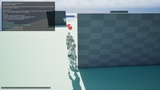
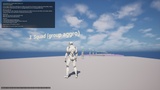
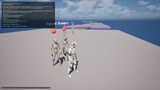
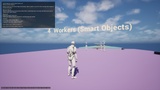
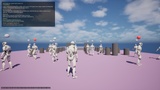
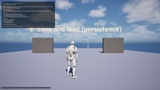
Description
Wardenmind
Demo showcase: Demo - Wardenmind
Documentation: Wardenmind Docs
Get started using the plugin: Wardenmin HowTo
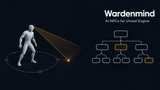
Wardenmind sits on top of the engine's own AI types and replaces none of them, so your own nodes, services and tasks mix freely with Wardenmind's.
- One profile asset per enemy type. A single Wardenmind Profile data asset holds every tuning value: team, perception ranges and angles, target memory, attack range and cooldown, flee threshold, patrol and leash radius, spawn waves, group aggro and more. Designers retune enemies without touching code. The defaults are a working guard.
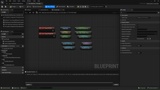
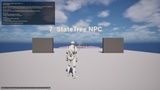
- Behavior Tree and StateTree, one rulebook. Ready-made patrol, chase, attack, flee, investigate and coarse-patrol nodes exist for both. Both paths call the same decision rules, so they cannot drift apart. Mix them freely with your own nodes.
- Shared threat memory. Sight and hearing feed one threat state per agent: target, line of sight, last known location and last noise. It handles lost sight, spent leads and destroyed targets. Noises and ally alerts only create investigate leads; they never hand an agent a target it has not seen.
- Group aggro. When one enemy spots you, allies in range are alerted along a chain of hops and go to investigate. They are never hard-locked onto you.
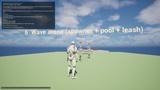
- Wave spawner, leash and pooling. Spawn timed waves from an object pool, cap how many are alive, and pull strays back to the pool. Parked pawns have their brains, timers and perception stopped and restarted cleanly on reuse.
- Teams for Blueprint-only pawns. A team component gives Blueprint characters a team and an attitude, which the engine's team interface only allows in C++.
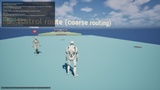
- Coarse routing. Patrol large levels along an authored waypoint graph with A\*, walked hop by hop on the NavMesh.
- Smart Object use. One task claims, walks to, uses and releases a slot, and frees the claim on every exit path.
- EQS additions. A cheap coarse-range test and a threat context.
- Mass crowds. Large populations stay as lightweight dormant Mass entities and awaken into full AI pawns near a player, then sleep again. Static stand-in meshes are drawn for clients.
- Save and load. Saves Wardenmind's own state (threat leads, home locations, wave progress, kill counts) per level, in per-engine-version save slots.
- Multiplayer. Server-authoritative AI with a small replicated presentation state (alert level, target, health percent), per-alert-level network update rates and idle dormancy.
- Optional LLM hook. A provider-agnostic request/response channel for barks and flavour text. You supply the provider; Wardenmind ships no backend and never acts on the answer.
- Self-contained. One folder in `Plugins/`. Pooling, A\* and graph search are embedded as private modules, so there are no other plugins to install besides the engine plugins listed below.
Works with Blueprints and C++
Everything is exposed to Blueprint. C++ users get the full API, overridable hooks, and the decision rules as a header you can reuse in your own nodes.
What it is not
Wardenmind does not replace Unreal's AI, add a perception sense, or ship combat, health, animation, meshes or art. It has no editor tooling beyond the standard asset editor. Mass support is awaken/sleep plus static stand-ins only, with no Mass-driven movement or animation. Coarse routing is for patrol only.