Descripción
The Ultimate C4D-Style MoGraph & Procedural Instancing Framework
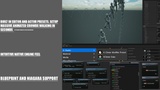
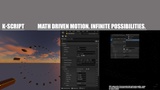
K-Cloner (the actual name of the plugin) is a massive, production-ready C++ framework for Unreal Engine 5 that brings the power of the industry-standard C4D-style MoGraph workflow directly into the real-time environment.
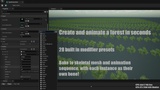
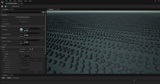
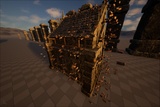
Unfamiliar with mograph systems? To put it simply, K-Cloner allows you to animate anything procedurally and allows the world to react to these procedural animations (effectors). This can be used for anything, whether its a jumping animation for a character, an attack combo, weapon sway, a forest of 10,000 trees all offset from each other... You could animate a full game with just this plugin alone! It works on both static meshes and skeletal meshes and this also includes a real time scripting system allowing you to add even more procedural animations through the power of math!
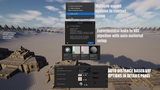
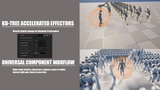
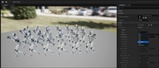
You can clone hundreds of skeletal meshes in a scene and animate them all procedurally allowing whole crowds to be procedurally animated differently from each other... and the best part? The only thing you have to do is tweak sliders. Getting started with this is so easy, even someone with no experience could learn how this works in 5 minutes. Just open the built in editor, pick a static or skeletal mesh and you will see the power this plugin provides. The built in editor allows for saving animations as well so think of it as an all new animation suite for UE5. It can transform any static and dull world, into living within minutes.
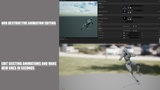
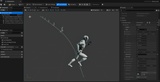
Have a set of old animations or marketplace animations? This allows you to procedurally tweak existing skeletal mesh animations as well and add procedural layers on top of it. You can stack dozens of procedural layers on top of the other and then save them as new animations allowing for a whole new workflow of non-destructive animation in UE5.
Because this was built with C++, you can also use the power K-Cloner provides with blueprints, almost every function is exposed to BP! There are way more advanced features built into this as well that power users and veterans will already know based off prior VFX experience! New users to the world of mograph will also find this extremely easy to learn as it was made with beginners in mind, no documentation or extensive reading needed!
Here is some extra info below on just a couple of features this brings to the table. Some of it may sound like rocket science however as mentioned before just open the built in editor and you will understand what these features are through hands on learning.
Core Distribution & Combinatorial Layouts
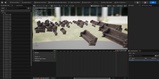
Generate complex layouts by stacking multiple distribution layers (e.g., a Grid on a Spline, or a Radial array on a Mesh Surface) using the FKClonerDistributionLayer architecture.
Radial (Align to radius with procedural alignment)
Linear (Step-based offset accumulations)
Spline (Align to custom spline paths using USplineComponent evaluation)
Honeycomb (Offset hex-grid patterns)
Scatter (Randomized distribution within a bounded volume)
Mesh Surface (Sample points via Vertex, Surface, or Volume with custom seed states)
Single (Precise manual placement)
Hybrid Skeletal & VAT Rendering
K-Cloner features a robust Skeletal Mesh instancing system, governed by the EKClonerSkeletalMode enum, allowing you to balance fidelity and performance:
Physics/IK Mode: Full skeletal animation component evaluation for hero close-ups.
VAT/Baked Mode: Instanced Vertex Animation Textures rendering on a secondary HISM component for thousands of characters with zero skeletal CPU overhead.
Auto (Distance-Based) LOD: Seamlessly and automatically transition from expensive Physics/IK components to ultra-fast baked VAT meshes based on a configurable camera distance threshold.
The Non-Destructive Modifier Stack
Audio (Spectrum Reactive): Uses the AudioSynesthesia plugin to analyze audio frequencies and drive clone Scale, Position, Rotation, or CustomData. You can drive animation through any audio files or in game music you have.
Texture: Sample grayscale UTexture2D maps across your clones to drive physical displacement, scale, or rotation. ex: if you want to drive an armada of clones with a texture or image you have, this samples that image and makes their layout based on it.
Inheritance: Seamlessly morph transform matrices between two entirely different AKClonerActor layouts in the world.
Color: Drive per-instance custom data directly into your materials.
Transform Drivers: Orbit, Float, and Pulse (Sine-wave driven axis spins, floating translation, and breathing scales).
Propagation: Wave (directional offset waves) and Step (cascading accumulative transforms).
Organic Motion: Shake (High-frequency Perlin noise jitter) and Sway (Complex, stacked sine-wave wind swaying with cross-axis depth, perfect for foliage).
Physics Emulation: Bounce (Squash-and-stretch dynamics), Elastic (Damped spring oscillation), and Pendulum (Angular swinging).
Mathematical Paths: Lissajous (Overlapping frequency-ratio curves) and Figure 8 (Infinity-symbol tracing).
Continuous Motion: Tumble (Constant random spin) and Vortex (Swirling rotational pulls).
Flow Control: Delay (Shifts time for following modifiers, creating domino effects).
Noise: Fluid-like Curl Noise for smooth, organic wandering (with configurable positional/rotational influence).
Fields: Attract/Repel (Target pulling with 1.0 to 5.0 falloff exponents), Push (Explosive radial force), and Gravity.
Constraints: Target (Look-at constraints targeting static vectors, specific Actors, or Actor Component tags).
K-Script & Procedural Authoring
For ultimate control, K-Cloner integrates K-Script, a lightning-fast Math Expression Engine powered by the third-party ExprTk library.
Write C-style mathematical logic (e.g., p.y += sin(t + i 0.1) v0;) directly in the Details panel to drive transforms based on time (t), instance index (i), total count (n), and user-defined variables (v0, v1...).
Modifier Presets: Package your K-Script logic into shareable UKClonerModifierPreset DataAssets, exposing specific variables as custom UI sliders for team libraries or DLC modifier packs.
The Tracer System
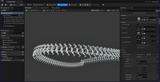
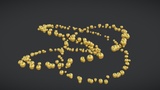
Track the motion history of specific clones using AKClonerTracer to procedurally generate USplineComponent paths in real-time. Control trail length, sample rates, minimum sample distances, and trail widths. Ideal for rendering motion trails, particle ribbons, and time-lapse light effects.
Animation Authoring & Output Baking Suite
A comprehensive toolkit for converting procedural real-time evaluations into highly optimized, deployable production assets.
Anim Tweak Mode: Ingest an existing Skeletal Animation Sequence, run it through the MoGraph modifier stack to add procedural noise or forces, and bake the result directly into a new, modified animation asset.
Bake to Static Mesh: Merge thousands of instances into a single optimized UStaticMesh with automatic LOD generation, collision generation, distance field support, and vertex welding.
One-Click VAT Generation & Auto-Material Setup: Sample cloner animations and bake them into Low (8-bit), High (16-bit), or Ultra (32-bit HDR) Vertex Animation Textures. K-Cloner automatically builds the corresponding VAT Material Instance, wires up the Position/Rotation/Normal textures, calculates the accurate bounding box metadata, and sets up the UV instance ID lookups.
Required Plugins: Niagara, AudioSynesthesia, GeometryCache
Support: [email protected]