説明
Feed it a handful of names you like. Get an endless supply that sounds like it came from the same world.
Markov Generator learns how your own reference lists sound — their letter rhythms, their word pairings — and produces new entries that match. Not random letter soup, and no hardcoded name bank to maintain as your game grows.
Three modes, one machine
The table, the weights and the walk are identical in all three. Only the unit changes.
Syllabic builds from characters — character names, cities, planets, factions, spells.
Word builds from words — dungeon names, ship classes, item titles, anything assembled from a vocabulary.
Text builds from a continuous corpus — flavour text, ambient dialogue, item descriptions.
Depth is the dial
Depth decides whether the output looks invented or plagiarised. Depth 2 is the usual choice for names: enough structure to inherit the feel of the source, loose enough to invent. Depth 1 gives you strangeness. Depth 3 and above echoes the input back unless the corpus is large. One number, and you tune the whole result.
Reproducible when you need it, random when you don't
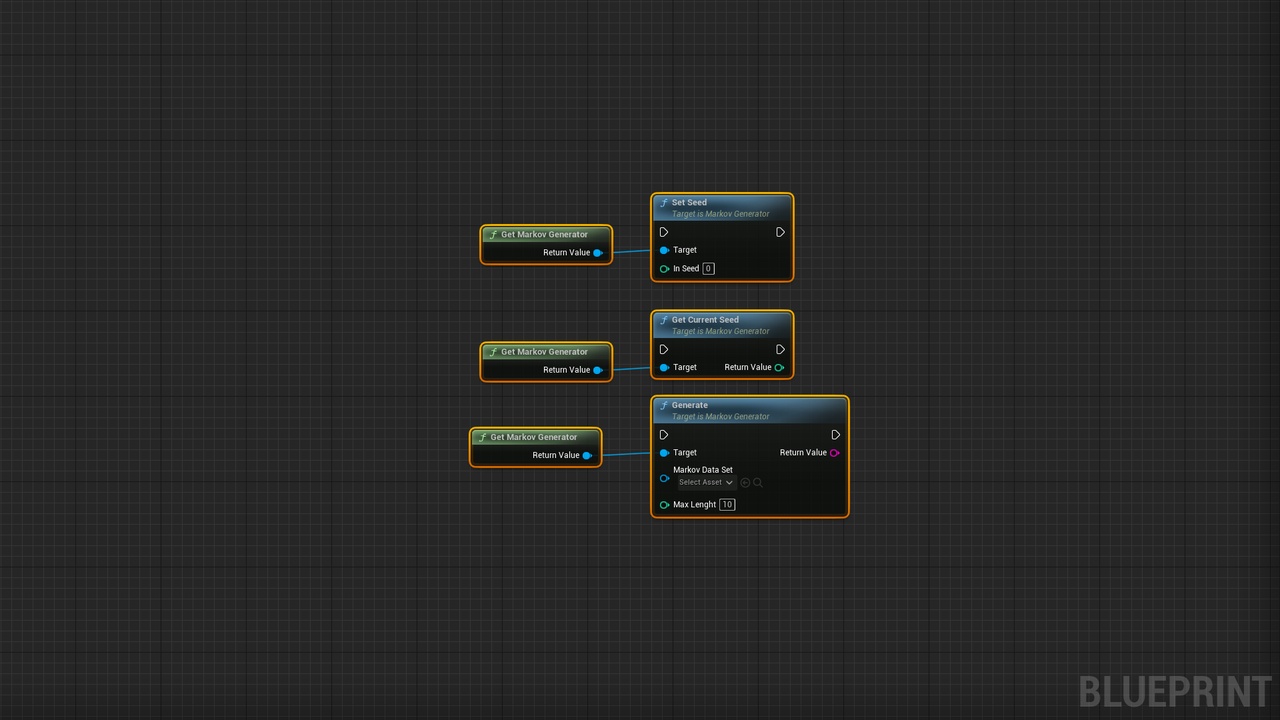
The generator seeds itself randomly, so two runs of the same build give different names. Call Set Seed before generating and the sequence is deterministic — seeded maps, replays, tests. Get Current Seed hands you back what was used, to store and replay later.
Generate Unique re-rolls whenever the result is already in your input list, so a populated city never shows the same name twice.
Blueprint, no C++ required
Get Markov Generator · Generate · Set Seed · Get Current Seed · Is Data Set Generated · Build Markov Data Set. Markov Data Set is a first-class Blueprint variable type, so designers wire it into gameplay without touching code.
Built for shipping
Nothing is built while the game runs. Tables are precomputed in the editor, and a data set left unbuilt is built automatically on its way into the package — a build can no longer ship a data set that silently generates nothing. Generation walks an index built once per data set, so calls stay cheap at scale.
Large corpora build in a single pass. A list of ten names or a novel's worth of text, same workflow.
Included
Sample data sets for each mode, a usage example in the plugin content folder, and full documentation covering how the table is built and how to tune it.
Documentation : https://t4lus.io/docs/markov-generator/
Updating from 1.4 — please rebuild your data sets. 1.5 corrects a set of defects in the chain itself, and existing tables keep the old behaviour until rebuilt. Open each data set, press Build Markov Data Set, save. Blueprints saved with 1.4 keep working — the renamed Max Length pin and the scoped enum both ship with redirects. Full changelog included with the plugin.