Descrição
Discord Support/ Group Of Friends You Can Bounce Ideas Off
8k Textures
Lore: (ONLY FICTIONAL)
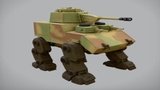
Type O-I-M – “The Land Yamato”
(Unofficially “The Super-Heavy Walker” or simply “O-I-M”)
Japan did not build this machine merely to compete with the Soviet Object 705 “KV Hybrid” and the other national heavies. They built it to win. Taking the unfinished O-I super-heavy tank design as the foundation, engineers shortened the enormous hull by roughly half, removed the heavy side skirts and excess rear structure, and mounted the remaining heavily armoured fighting compartment on a set of thick, multi-jointed robotic legs. The result was a 75–85 ton land battleship — Japan’s answer to the Yamato, translated from sea to soil.Standing 6.5–7.0 meters (approximately 21–23 feet) tall, the O-I-M looms over almost every other walker of the era. Maximum speed is a deliberate 15–20 km/h on flat ground, slower still in difficult terrain, yet the multi-jointed legs and wide feet allow it to cross trenches, rubble, and soft ground that would bog down conventional tracks.The primary turret carries either the long-barreled Type 92 105 mm cannon (muzzle velocity ~760 m/s, maximum range up to 18 km with streamlined shells, firing ~16 kg projectiles) or a shortened Type 96 150 mm howitzer (muzzle velocity ~540 m/s, range 10–12 km, firing heavy 31+ kg high-explosive shells). Both weapons deliver crushing firepower. The 105 mm offers better anti-armour reach and velocity; the 150 mm howitzer trades range and flat trajectory for devastating explosive effect against fortifications, lighter walkers, and anything caught in the open. Ammunition storage is reduced by the shortened hull, limiting sustained fire.Two forward secondary turrets mount 47 mm Type 1 tank guns (or high-caliber machine guns), fully operational for engaging infantry and lighter vehicles. There are no rear-facing weapons — the hull was cut short precisely behind the main turret, leaving the machine highly vulnerable to attacks from behind or the flanks. Frontal armour remains the original O-I specification of 150 mm vertical steel, making the nose extremely difficult to penetrate for most contemporary guns. The legs, however, carry only 50–75 mm of plating and represent the critical weak point; concentrated fire on the knee joints or actuators can immobilize the entire vehicle. In direct comparison with the other monsters of the age:
Against the Soviet Object 705 and British TOG-M, the O-I-M’s 150 mm frontal armour and heavy main gun make it a peer opponent in a frontal duel, though its exposed legs and complete lack of rear defence are serious liabilities.
Against the American Citadel or Bastion it holds a clear firepower and frontal protection advantage, but must be careful not to let the more numerous or mobile Allied designs work around to its sides or rear.
Lighter walkers (Churchill-M, Type 97-M, Object 706, Jäger, etc.) are generally outclassed in both protection and main-gun power, provided the O-I-M can bring its frontal arc to bear.
One hundred years later the few surviving examples still dominate any landscape they occupy — slow, towering, and unmistakably Japanese in their oversized, multi-turreted aggression. They remain the heaviest pure land combatants the Empire ever fielded, a final, desperate attempt to create a war-winning monster on the same scale as the Yamato. It was not built to compete.
It was built to win.
And it still stands.