Descrição
Discord Support/ Group Of Friends You Can Bounce Ideas Off
Enjoyed the asset? Leave a review and unlock bonus mechs, skins, and exclusive variants in our Discord community!
8k Textures
Lore: (ONLY FICTIONAL)
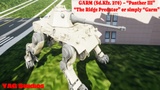
Project GARM (Sd.Kfz. 270) – “Panther III”
(Unofficially “The Ridge Predator” or simply “Garm”)Germany completed this machine before the lighter three-legged Jäger prototypes. While other nations raced to build ever-larger siege walkers, German designers pursued a different path: a pure long-range sniper mech optimized for extreme-range ambush and kinetic deletion.The Sd.Kfz. 270 “Garm” pairs a modified Panther II Schmalturm (narrow turret) — already renowned for its excellent armor layout and stereoscopic rangefinders — with an advanced quad-pedal walking chassis. The turret retains the Panther II’s strong frontal protection and superior optics, further enhanced with the Infrarot-Zielgerät 1221 “Falke” night-vision system for low-light hunter-killer work.Its primary weapon is the experimental 8.8 cm / 7.7 cm KwK 46 Gerlich-Squeeze Gun. Engineers started with a 20.5-foot Tiger II barrel blank and fitted a smoothbore tapered muzzle sleeve, creating a high-velocity squeezebore cannon. It fires specialized Pzgr. 41 squeeze-bore shells (tungsten-carbide core) using automated combustible cartridge cases. Muzzle velocity reaches approximately 1,530 m/s (Mach 4.5), allowing the darts to punch cleanly through heavy armor at ranges well beyond two miles when conditions and optics permit.The chassis is entirely pneumatic. A central Maybach engine drives constant-spin mechanical shafts, planetary gears, and worm drives; high-pressure air clutches handle all joint movement and clamping. There are no hydraulic fluids to leak or burn. If enemy fire punctures an air line, an ingenious weapon-assisted recovery system activates: a fraction of the gun’s enormous propellant gas (up to 60,000 PSI) is bled into an expansion chamber, slamming a free-piston that instantly recharges the pneumatic tanks. The system has a tactical drawback. When the pneumatics are already at full pressure, the next shot forces a massive spring-loaded relief valve on the turret bustle to snap open with a deafening CRACK-HISSSSS, venting a visible cloud of white smoke and debris. After every few rounds the crew must immediately reposition or risk revealing their location. The four articulated legs with deep-digging clawed anchors allow the Garm to scale rocky cliffs, scramble through urban rubble, and plant itself firmly against the violent recoil of its ultra-high-velocity gun. In the attack position it can drop into a low “prone” profile, nearly disappearing against the terrain while its claws lock into the earth. Standing roughly 22–25 feet (6.7–7.6 m) tall on its legs (far lower when prone), the Garm was never intended for frontal assaults. It was an apex ridge predator — silent until the shot, lethal at extreme range, then gone before retaliation could arrive. Only a small number of prototypes were finished before the collapse. One hundred years later the surviving machines still exist, continuing their original role as mobile, long-range hunters. They remain among the most dangerous of the old monsters precisely because they are rarely seen until it is already too Late. It was built first among the German walkers.
It traded mass and secondary weapons for velocity, stealth, and reach.
And it still waits on the high ground.