




Descrição
[Demonstration Video] [Documentation] [Discord]
The Multipurpose Spawner is designed to provide a simple, flexible way to spawn actors of any class at any location. Spawns are fully customizable and occur randomly within a predefined area, one at a time, at a set interval, until a maximum number of actors is reached.
You can choose between two spawn types:
🔹Grounded Spawns: Actors are placed on surfaces, with the option to follow the slope and apply custom rotations per spawn.
🔹Midair Spawns: Actors are scattered within a spherical area, floating in space.
Because grounded spawning requires valid surfaces, the system includes a filtering method: simply assign the “Spawnable” tag to surfaces where spawning is allowed. All other surfaces will automatically be ignored, helping you avoid unwanted placements.
To prevent overlapping or clipping, the spawner also includes a collision check. Based on a user-defined radius, it ensures an actor won't spawn if there's already another actor or an obstacle in the way. This keeps the spawn area clean and avoids visual or gameplay issues.
Included Examples
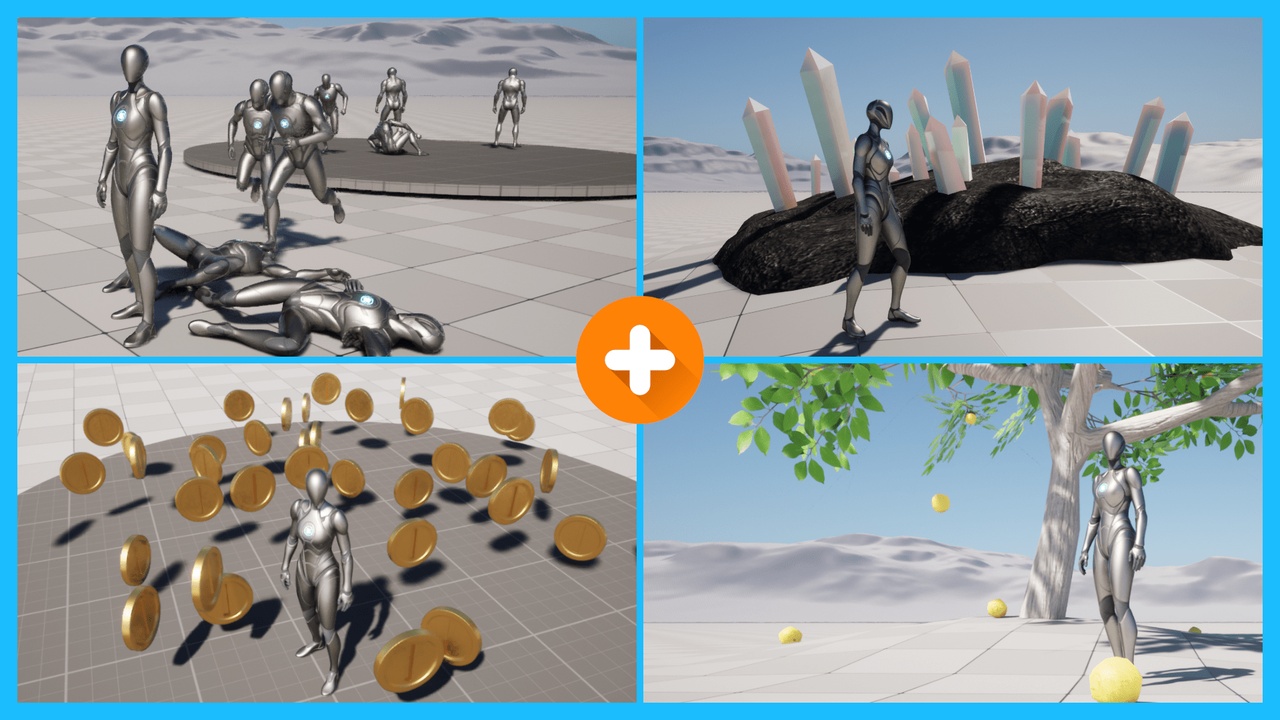
To help you get started, the Multipurpose Spawner includes four fully functional example actor classes. These demonstrate different use cases and provide inspiration for integrating the system into your own project. All components and examples are fully available for use and modification.
Network Replication
The Multipurpose Spawner is a server-side actor. Spawn locations replicate by default, but because of the randomized nature of rotations, scales, and other actor-specific components, it's recommended that you enable replication for those properties individually, just as shown in the included examples.
Updates
(Updates may occur taking customer suggestions and bug reports into consideration.)
Version V2 :
Added the possibility to spawn multiple actor classes randomly from the same spawner.
Minor bug fixes.
Version V3 :
The spawned actors counter has been significantly optimized.
Instead of using Get All Actors with Tag to count spawned actors, the system now relies on a local array, dramatically improving performance by tracking only the actors spawned by the spawner itself.