Description
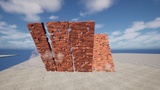
Blueprint-only destructible scenery: walls, floors, pillars, towers, bridges, stairs, glass panes, paper piles and 48 pieces of furniture that break where they are hit, fall when nothing holds them any more, and rebuild on demand.
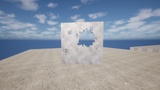
It breaks where it is hit. A block is a grid of cells, and each cell splits into irregular shards. One shot digs a round hollow; a second shot on the same spot opens a hole you can shoot through; one more on the same cell opens it wide. An explosion cuts a spherical breach. There are no hit points: what is hit is what goes.
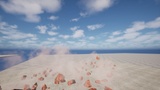
What nothing holds any more falls. You tick the faces of a block that are anchored and list the actors that carry it. After each breach, whatever no longer holds to an anchor comes off in one piece and comes down: a thin stretch of wall breaks up as it falls and falls over flat, a thick block holds until it lands, breaks in two and is crushed into its own rubble. A heap of rubble is left under the dust. A slab that lists its two walls comes down when one of them gives way.
It answers the engine's own damage nodes. Apply Point Damage works as it is: connect the hit result of your line trace and shoot. Apply Radial Damage works within the engine's line-of-sight rule; one extra node, Explode Scenery, has no such limit. Direct calls exist for melee weapons, traps and scripted events, and an optional damage type sets the size of the hole for each weapon.
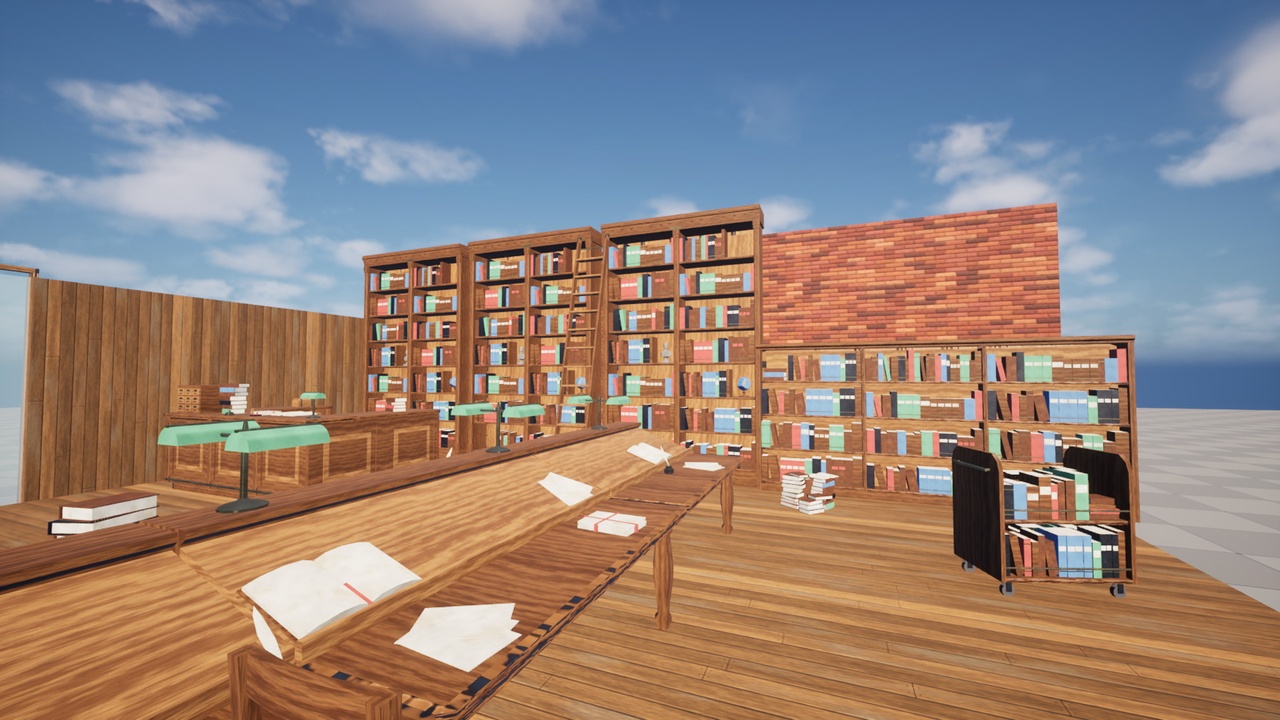
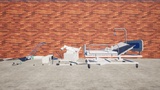
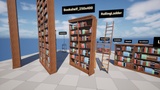
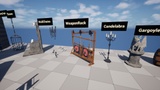
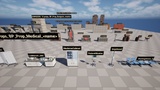
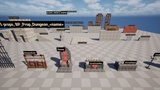
Furniture made of pieces. 48 props in four families: Library 12, Dungeon 15, Medical 17, and 4 wooden partitions and window frames. 1,080 breakable pieces in all. The piece you hit comes off; what it carried falls with it; when too much of the structure is gone, the whole prop collapses. 33 pieces of glass and ceramics shatter instead.
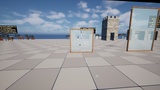
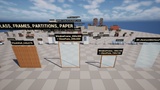
Glass and paper. A glass pane takes a hole and a web of cracks at each shot and comes down at the fourth in a rain of shards; it bursts when the window frame that carries it is shot away. A paper pile scatters at the first damage.
Dressed, and it makes noise. One world-aligned material textures every block and every prop without using mesh UVs: 11 surfaces (colour and relief), 28 instances, yours to replace. 24 sound cues play 82 takes at random, so two hits in a row do not sound the same, and what falls lands with the sound of its material: rubble, wood or sheet metal. What breaks raises a puff of dust, drawn by one material and no particle system; an empty slot takes your own Niagara System for anything more.
Made to be changed. Blueprints only: no C++, no code plugin, nothing to compile. 149 settings, each with its tooltip; every function has its description, and the graphs are commented (205 comment boxes). Presets are children with no graph; four shapes (pillar, tower, bridge, stairs) show how one overridden function invents a shape; 11 event dispatchers report hits, breaches, falls and collapses for your score, your quests or your AI.
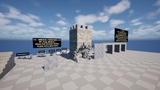
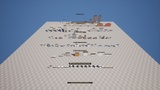
A manual you can play. A demo map of 18 stations, each with a sign that says what to try, and an overview map that shows every element side by side. A user guide of 21 chapters, in English and in French, with every setting, measured costs and the known limitations stated plainly.
What is included (639 assets)
• Core Blueprints (9): the common parent, the block, the falling chunk, the debris piece, the Destruction Manager (budgets, explosions, reset), the prop, its breakable piece, the glass pane, the paper pile
• Presets (17): the wall (600 × 300 × 20 cm) and six variants (brick, wood, softened edges, rounded edges, worn, heavily worn); the floor (600 × 600 × 20 cm) and two worn variants; the low cover; the metal plate (150 × 150 cm) and its wall-sized version (300 × 300 cm); two glass panes (150 × 150 and 200 × 300 cm); two paper piles
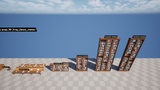
• Shapes (4): pillar (125 × 125 × 300 cm), tower (300 × 300 × 600 cm), bridge (150 × 1300 × 300 cm), stairs (150 × 400 × 200 cm)
• Damage types (3): standard, small calibre, heavy calibre
• Demo Blueprints (2): a flying pawn that shoots, and its HUD
• Furniture (48): Library 12, Dungeon 15, Medical 17, Common 4
• Static meshes (386): 301 furniture parts, 57 shard meshes, 8 edge pieces, 20 debris meshes
• Materials (36): 4 materials and 32 instances
• Textures (25): 11 surfaces (colour + normal) and 3 glass crack pictures
• Sounds (107): 24 sound cues, 82 takes, 1 attenuation setting
• Maps (2): the demo map and the overview map
Good to know before buying
• Single player. Nothing is replicated.
• Support is declared, not guessed: anchored faces to tick, support actors to list. A stack of blocks does not hold or fall by itself.
• An explosion is a hitch: the whole breach is cut in the frame of the call (21 to 216 ms measured in the editor for a 150 cm breach on an intact block, depending on the block). Smaller radii and smaller blocks cost less. A chunk that comes off is a hitch too: 35 to 62 ms measured in the frame it leaves, for chunks of 60 to 110 cells.
• The falling chunk is not a physics body: its fall, its tumble, its falling over flat and its crush are worked out by its own graph; while a thin chunk falls over, and while a thick one is crushed, it passes through what stands in its way or carries it (on a thin floor over a void, a block being crushed shows underneath for a second or two). It hurts nobody. Loose groups that are too large vanish in a burst of debris.
• The debris and the rubble do not stay: a pool of 64 debris for the level, gone after 5 seconds; the heap of rubble a chunk leaves sinks into the ground after 20 seconds (a setting).
• A furniture piece comes off whole; it does not break into smaller parts. Fallen pieces block neither characters nor shots.
• The dust is the only visual effect shipped (soft balls drawn by a material, not particles), and no state is saved: a half-broken wall is not reloaded.
• Light the destructibles with movable lights: a baked shadow does not follow a wall with a hole in it.
• Your own material needs the usage "Used with Instanced Static Meshes"; the editor adds it the first time the material is used on a block.
• Engine limit: a standalone game that is not packaged can stop while loading a level that holds several heavily worn walls ("Runaway loop detected"); raising Maximum Loop Iteration Count in the Project Settings solves it. The packaged game and the game played in the editor load the same level without it. Collapsing every block of a level in the same frame reaches the same limit.
• In the editor log, the engine writes harmless navigation warnings ("LogNavigationDirtyArea ... empty bounds") where a navigation system exists. A level with a navigation mesh was not tested.
• Not tested: a shipping build, another platform than Windows, another engine version than 5.8. A product made of Blueprints may need an update for a new engine version.
Engine content the product refers to
The product copies nothing from the engine. It refers to 12 engine assets that come with Unreal Engine 5.8: the basic cube (the mesh of a cell), the basic sphere (the soft ball of the dust), two engine materials left in the slots of the imported meshes, the standard Blueprint macros, and the floor, sky, clouds and icons of the basic map template in the two maps. The guide lists them one by one, with how to replace each.
Documentation and support
A user guide of 21 chapters, in English and in French. Inside the product: a tooltip on every setting, a Quick Help text on every actor, comments in every graph, and the signs of the demo map.
Support: [email protected]
About the pictures
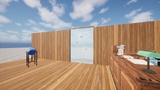
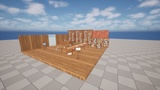
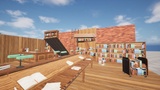
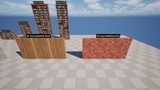
The reading room in the first pictures, and the four small sets of the trailer (a yard, a metal plate, a row of Dungeon props, a row of Medical props), are showcase scenes assembled from the product's own blocks and props; they are not among the 2 shipped maps (the demo map and the overview map).