
Descripción
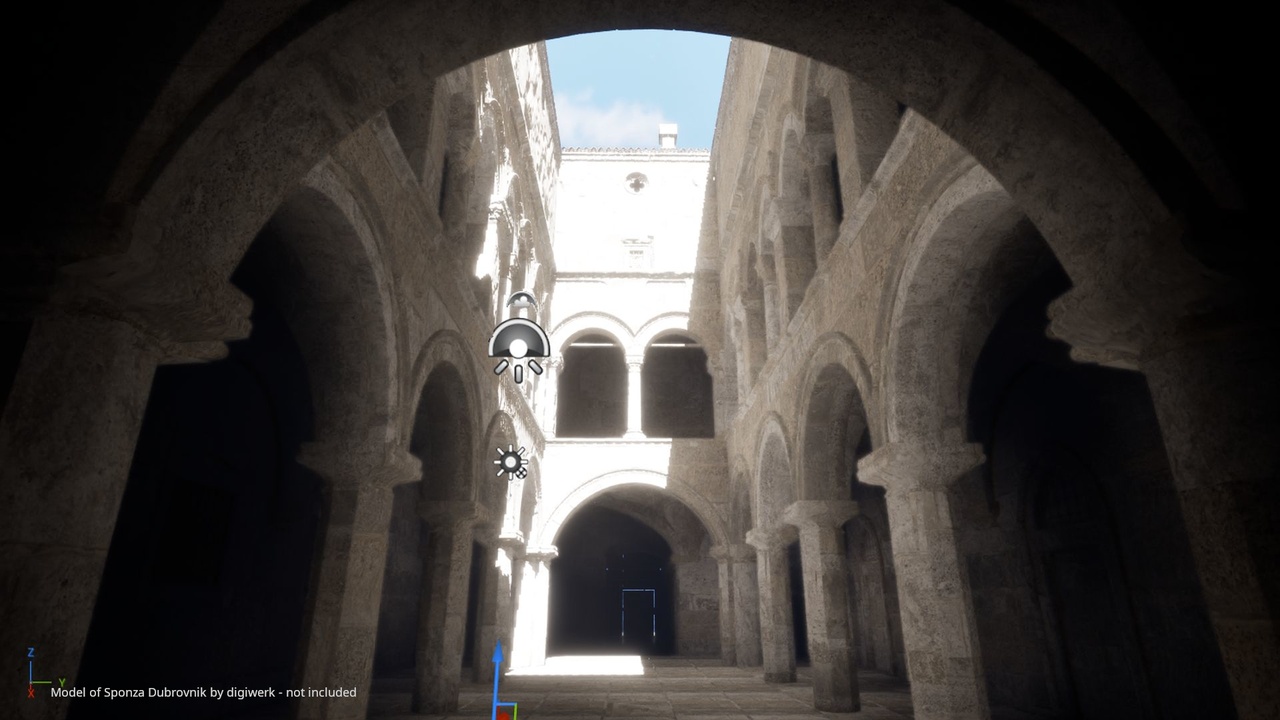
Radiance Response Field Global Illumination
A revolutionary new way to capture Global Illumination without using RT cores or real time GPU heavy load. A high frequency Global Illumination capture into the GBuffer of the GPU. 1 volume can be entire level it takes about 10-200 mb GPU buffer memory. But it varies on complexity and size.
Very easy to use after installation
Disable Lumen and ray tracing shadows inside your project.
Drop the RRF-GI Volume inside your scene.
Capture the Radiance Response Field Global Illumination and save it to a volume file.
-No Lumen
-No Lightmaps
Ultra Light compared to any other method or Lumen, it bakes in few seconds captures a vector field of GI inside the pre-selected volume.
Can be combined with other rendering pipelines to create a unique look.
Specifically designed to run on lower hardware like VR, phones, or older PC hardware dx 11 or dx 12.
Offline / GI capture: Geometry + materials → lighting-response field Runtime: Current lights + camera + local surface data ↓ GI reconstruction
Pipeline
GBuffer → light-to-basis projection → response-field evaluation → screen-space contact correction → temporal reconstruction (depth/velocity reject + neighborhood clamp) → composite onto scene color (indirect * albedo)
Optional later stages from the original design, not in this first drop:
Surface-cluster bake instead of a uniform volume
Portal / door response states
High-end ray-query correction only where the field is uncertain
Event-driven invalidation for destroyed geometry
Design notes
RRF-GI is aimed at authored levels where geometry is mostly static and lighting changes inside known limits. It should scale to hardware without DXR. Dynamic characters should sample the field and add local contact lighting rather than rebuilding the world.
It will not match offline path tracing for mirrors, tiny occludes, or arbitrary destruction. Those cases need local visibility fallbacks.
Requirements
Unreal Engine 5.6 + tested
Windows 64-bit
Deferred renderer (GBuffer)