

Opis
Personica AI: LLM-Integrated Character State & Decision Framework
Product Website | Support Documentation | Community Discord
Build dynamic worlds that respond consistently to player pressure without surrendering authorial control.
Personica is a production-ready LLM integration system (both local and cloud) for Unreal Engine that helps designers manage NPC memory, personality, and decision-making using a controlled, game-first architecture. It also combines Utility AI with LLM assistance to interpret player intent and create dynamic game behavior. No need to hard-code algorithms or triggers for every unique action or update.
Personica negotiates state changes within developer-defined boundaries.
Designed for a New Generation of Characters
Instead of just wrapping an API endpoint, Personica acts as a character state mediation layer built specifically for games, multiplayer environments, and production pipelines.
This system allows AI models to propose interpretations (intent, sentiment, significance), while your game remains the final authority over:
What NPCs do and remember
How traits and personalities may evolve
Which gameplay actions are allowed
When mutation is permitted (or locked entirely)
Key Capabilities
Utility AI + Intent Interpretation
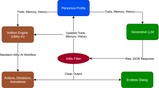
Personica bridges dialog and gameplay by translating player input into structured intent signals that your existing AI systems can act on immediately. An LLM can directly choose a utility action based on the context of a conversation, or it can update traits in the NPC's Personica Profile that shape the utility scores.
Curated Memory System
NPCs track short-term context and long-term memories using relevance-based scoring. Important events persist, while noise naturally fades. Memory creation is optional, auditable, and fully configurable.
Controlled Personality Evolution
Developer-defined traits such as Trust, Aggression, or Curiosity can evolve over time, but only within designer-approved ranges. Personality mutation is mediated by policy assets and can be disabled or locked at any stage of development.
Performance-First Architecture
Built with real games in mind:
Server-authoritative execution
Built-in LOD tiers to reduce cost and complexity
Request throttling and traffic control to prevent API flooding
Safe cancellation and interruption handling
Creator-First Control
Personica is designed for modularity and customization that empowers creators, designers, and writers. Build from the ground up using Personica's full abilities, or incorporate Personica into your existing behavior, dialog, or AI system.
Provider-Agnostic
Compatible with OpenAI, Anthropic, Gemini, and local LLMs (via llama.cpp). Swap providers without rewriting your gameplay logic.
Use Case Examples
Guard NPC behavior evolves over time
A town guard becomes more suspicious and aggressive toward the player after repeated nighttime trespassing, even if the dialog stays polite.
Faction trust changes without dialog
Helping a rival faction silently lowers an NPC merchant’s prices for allies and raises them for enemies, without the NPC ever explaining why.
Quest outcomes alter NPC personality
Sparing an enemy causes them to become fearful and evasive later, while killing their ally makes them hostile on sight.
International relations analysis in Grand Strategies
After repeated border skirmishes and broken treaties, Personica mutates the diplomatic “Trust” state between two nations, causing future negotiations to start hostile even if the player offers generous terms.
Game systems that learn from previous events
The game world’s governing council “remembers” which policies historically stabilized the economy and begins favoring similar decisions autonomously.
NPC memory affects future gameplay options
An NPC refuses to help open a locked gate because they remember you previously betraying them during a side quest.
Dynamic quest gating without branching trees
A quest becomes unavailable because the NPC’s trust never reached the required threshold, not because the player chose a “wrong” option.
“But I can do all that already without Personica!”
Yes, and you should continue to! Personica AI is designed to work alongside hand-scripted game design, not replace it completely. The plugin can take over for the tedious algorithm and branching construction required in traditional game design. Focus your time and energy on building the main storylines, tense actions points, and key systems, and spend less time tweaking algorithms and trigger rules for minor functionality that a player may never see.
Building a complex game world requires both wide and deep design. Personica takes over the “width” of game design so you can focus on the “depth.”
Technical Overview
Type: C++ Actor Component (Blueprint-callable)
Input: Text, Gameplay Tags, Developer-specified context
Output: Intent Signals, Utility Actions, Trait Updates, Long-term Memories, optional dialog
Networking: Server-authoritative with built-in request gating
Safety: Policy-driven mutation gates, optional filters, deterministic chokepoints
Platforms: Windows, Mac, Linux
Why Personica?
Most AI tools focus on generating text.
Personica focuses on protecting character integrity.
Whether you’re building an RPG, immersive sim, life sim, or co-op experience, Personica helps your NPCs remain believable, reactive, and consistent, even when players behave unpredictably.
Personica empowers writers and designers by giving them better tools to ship believable characters.
Questions, queries, comments? Join the community Discord!
***AI Usage Disclaimer: LLM tools were used to suggest updates or write comments in Personica's code. In cases where LLM changes were incorporated, humans reviewed, tested, and approved their incorporation. It is our responsibility alone to ensure AI suggested design is feasible, clean, and safe to run.***